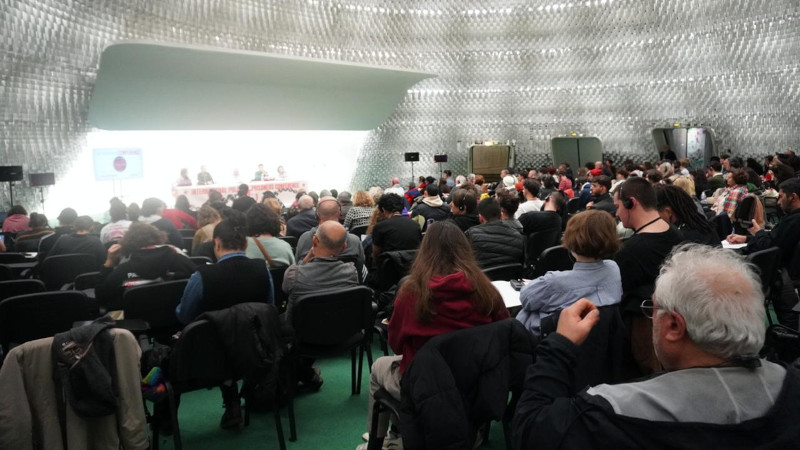
Issues and problems surrounding internationalist support for revolutionary prisoners (Second contribution by the IRH to the International Conference in Paris for Political Prisoners)

Introduction
The International Red Help makes no secret of its shortcomings and weaknesses. Nevertheless, we believe that our 25 years of uninterrupted experience in internationalist support for revolutionary prisoners gives us a certain expertise on the subject of this round table.
These 25 years have forced us to confront a number of contradictions and navigate a number of crises, which allow us to assert that a seemingly simple issue such as internationalist support for revolutionary prisoners is in fact a specific and complex issue that exposes us to difficult choices and unfortunate misunderstandings.
The three issues
As we tried to make clear in our first intervention, whether they like it or not, whether they are ready or not, political prisoners become a symbol and a triple issue for both sides.
The first issue is therefore ideological.
This is the most basic issue, the one that reveals, in the broadest possible sense, that there are two sides: the exploited and oppressed, and the exploiters and oppressors. It is also the issue that affirms that struggle is possible, that victory is possible.
If the bourgeoisie succeeds in displaying repentant prisoners, it strengthens its power. On the contrary, if the masses perceive the accused revolutionaries as courageous, consistent and determined activists, the entire revolutionary cause is strengthened.
In addition to the general ideological issues, there are also political issues at stake. Prisoners are representatives of a form of political action, a strategic perspective, or a specific organisational project, based on analysis and aimed at specific objectives.
Quite naturally, prisoners will want to serve their specific political project. In their statements, they will not limit themselves to a simple attack on the class nature of the state and the justice system, nor to a simple affirmation of the legitimacy of the struggle. They will attempt to promote their own political, strategic and tactical choices.
The distinction between ideological and political issues is important.
Finally, there are practical issues: avoiding heavy sentences at trial, getting out of solitary confinement, obtaining visits and means of communication, avoiding extradition, obtaining release, etc. All these objectives, in line with what we outlined in our first intervention, allow prisoners to remain political subjects.
It is important to understand that these issues are sometimes complementary, sometimes contradictory – and it is sometimes difficult to distinguish between them.
For example, one might tend to think that a position of rupture in court (refusing to recognise the legitimacy of the court, etc.) will strengthen revolutionaries in the first issue (the ideological battle) but weaken them in the third issue (the criminal issue). There are exceptions to this, as demonstrated by the so-called ‘rupture’ defense, which, when it succeeds in putting the enemy on the defensive and exposing their contradictions, manages to win on all fronts. But the rule is rather that there is a criminal price to pay for an offensive ideological position.
Another example: a clear-cut political position can sometimes strengthen the ideological level, sometimes weaken it. For example, if prisoners defend the choices of their organisations or currents in a very sectarian manner, prioritising criticism of the choices of other revolutionaries over attacking the class enemy, then, ideologically, they may be counterproductive to the masses who have to witness factional quarrels.
International solidarity
Since its foundation, the International Red Help has taken on the task of supporting revolutionary prisoners and understands this support as part of its revolutionary activity. The revolutionary process is punctuated by phases that are sometimes ascending, sometimes descending, but always marked by a dialectic of struggle/repression/resistance to repression. The IRH understands the work of resistance to repression as both proactive and reactive. Proactive because the revolutionary movement must be made more resistant to repression, reactive because the revolutionary movement must be given the means to overcome the blows dealt by repression.
One might think that proactive work is purely technical and organisational: encrypting communications, compartmentalising organisations, thwarting surveillance, etc. In reality, it is above all ideological work. Only a good understanding of class antagonism allows for a good understanding of repression. Once repression is understood, not as a plague to be avoided, but as a trial to be overcome, it loses its stunning effect, it ceases to paralyse forces and immobilise activists.
Support for revolutionary prisoners can, depending on how it is carried out, weaken or strengthen this ideological battle.
If support for revolutionary prisoners is provided in a victimising manner, focusing on the injustices suffered, unfair convictions, rigged trials, the misapplication of laws, torture inflicted, harsh conditions of detention, lengthy imprisonment, etc., then the effect produced is, at worst, demobilisation, and at best, mobilisation on a humanitarian or bourgeois-democratic basis.
Conversely, if support for prisoners is provided in a political manner, focusing on the political identity of the prisoners, on the way in which they assert it, on the enemy’s inability to break it despite its relentless efforts, on everything that this relentlessness reveals about the enemy’s fear, then the effect produced is a powerful encouragement for the revolutionary camp.
The IRH is often asked to participate in international campaigns for particular groups of prisoners. As our resources are limited, we are forced to make choices, and these choices are based on political criteria. We give priority to prisoners and groups of prisoners whose stance in the face of repression helps to nourish and strengthen the revolutionary camp.
There are often misunderstandings on this point with forces that call on us to support this or that activist because, for example, they are a progressive journalist unjustly accused of being a clandestine revolutionary activist.
Of course, we want progressive journalists who have been unjustly accused to be released promptly, and we fully understand that clandestine revolutionary activists who have acted under the guise of “journalism” use this cover to protect themselves from prison sentences. But the IRH, which sees its struggle against repression as part of the revolution/counter-revolution dialectic, will prioritise revolutionary activists who identify themselves as such.
Similarly, certain forces highlight the most “innocent” profiles (according to bourgeois categories), thinking that this will facilitate solidarity campaigns. We favour the most “guilty” profiles because they allow us to affirm the revolutionary perspective and its ability to defeat the enemy.
This is why, in trials or detentions targeting groups of activists, we believe that mobilisations should focus on the cases of those accused who are most heavily attacked by the bourgeois justice system, or those prisoners who have received the most severe sentences.
Firstly, this avoids giving ammunition to those who seek to differentiate between cases (particularly democratic forces, who make their choices by supporting, for example, prisoners who are “unjustly accused” or “who do not have blood on their hands”).
It also allows, on the judicial level, to obtain better results even for those who are least targeted, by exploiting the bourgeois judicial system’s tendency to give very different sentences, more or less severe, in order to give the appearance of justice, balance and fairness.
In order to build strong and authentically revolutionary international support for revolutionary prisoners, we must value prisoners who openly defend the political and strategic projects of their group (even if we do not endorse them), prisoners who have managed to maintain a collective dynamic, either by remaining members of an outside group or by creating a resistance collective within the prison; in short prisoners who openly assume a break with the enemy, its police and judicial apparatus, its categories and its laws.
This does not mean, mind you, supporting only prisoners who have led the struggle at the highest level of antagonism, historical leaders, or fighters who have carried out extraordinary actions. The vast majority of activists are exposed to repression for low-intensity initiatives. The qualities we emphasise (accepting one’s previous commitment, taking an antagonistic position, refusing to collaborate, valuing collective struggle, etc.) apply equally to someone arrested at a picket line or captured in a guerrilla war.
Bourgeois democratic values
In its distant popular and revolutionary past, the bourgeoisie developed democratic and progressive values.
We know how selective this legacy has been – it has been denied, for example, to colonised peoples.
We also know that this democratic heritage is constantly being eroded. For example, the bourgeoisie has renounced its own definition of political prisoners. The category of ‘terrorist’ allows it to completely reverse its principles: a person imprisoned for fighting for a political cause is given a harsher sentence and is detained more harshly.
However, there remains an ideological issue, as the bourgeoisie continues to assert that these values are those of its system.
This gives rise to three types of contradictions:
– Firstly, the position of bourgeois and petty-bourgeois humanists and democrats who sincerely defend these values.
– Then there are the individuals and institutions that derive power and prestige from the socio-political mechanisms associated with this legacy and defend them in a corporate manner. We can thus
see judges making decisions that run counter to the wishes of those in power in order to assert their power and autonomy.
– Finally, there is the left wing of the system which, since adhering to the rules of capitalism, can only distinguish itself by raising societal and ideological issues. Although in the vast majority of cases it positions itself as the right wing of the system, it may occasionally take a progressive stance in order to save its image in the eyes of the masses. This does not happen spontaneously: the issue must be strongly debated among the masses before the left wing of the regime decides to take action.
The general shift to the right in societies has reduced the first category to a mere shadow of its former self. Comrades in dominated countries generally do not realise how weak the authentic bourgeois democratic forces are – sometimes even weaker than the revolutionary forces. As for the left wing of the system, it has no principles. We saw this again with its unqualified support for the genocide in Gaza. It took hundreds of thousands of demonstrators denouncing this genocide for the left to risk a few timid criticisms of the perpetrators.
Many forces on the revolutionary left continued to address the issue of prisoners in terms of the enemy, for example by calling for respect for the enemy’s rights. As IRH, we have broken with this old practice of appealing to bourgeois values and the forces of the left within the system.
We believe that the best way to support revolutionary prisoners is to promote their revolutionary positions.
Problems of internationalisation
The problems of international solidarity are specific. First, as we have seen, because it often involves supporting prisoners whose political identities sometimes differ from those of the supporting forces. A balance must be found between the supporting forces, which, as we explained in our first intervention, have a duty to relay the prisoners’ message, even if there are political disagreements, and the prisoners, who must respect the political identity of the international supporting forces and not expect them to become mere vehicles for the particular political, organisational and strategic projects of the prisoners.
But international solidarity is not only confronted with differences in political positions, it is also confronted with differences in political culture. And this is an issue that is generally overlooked.
In some countries, the demand for amnesty is part of the revolutionary movement’s demands, while in other countries it is advocated by representatives of capitulation and liquidation. In some countries, political culture requires that one debate with judges in court to defend one’s ideas; while in other countries, one does not debate with judges because that would be to recognise the legitimacy of the court. There are many such examples.
The prison struggle front is often determined, as we have seen, by symbolic issues. However, the same symbol can have a strong ideological impact in some societies and none in others, which explains why the same factor can lead to a fight to the death here and not even be a topic of conversation elsewhere. For example, wearing prison uniforms is unacceptable to prisoners in Turkey or Ireland, but of no concern to prisoners in Belgium or the United States. If we try to understand these differences in terms of “more radical/less radical” or “more just/less just”, we are completely mistaken. The battle of symbols can only be judged in direct relation to the specific political culture to which it echoes, and in which it resonates. Supporting imprisoned activists therefore involves not only understanding their political commitment and their political situation, but also their political culture.
Perspectives
As we can see, building international support for revolutionary prisoners requires analysis and choices on the part of both the prisoners themselves and the political forces supporting them. Beyond the natural reflex of solidarity, an expression of our belonging to the same camp, revolutionary prisoners and the political forces that support them must forge a relationship in which the realities, roles and objectives of each must be understood and respected. And this relationship itself must be thought of in an even more complex context involving the various agents of the enemy, sometimes in agreement, sometimes in rivalry, sometimes in conflict, as well as other forces that also obey their own logic, such as bourgeois democrats, lawyers, and families.
Our experience as IRH is limited, but sufficiently positive and encouraging to give us confidence in the possibility of extending and deepening support for revolutionary prisoners, and making this support part of the overall struggle for liberation